Target the exact step that needs practice.
High school courses cover a wide span of mathematics, from solving equations and interpreting functions to trigonometry, statistics, precalculus, and introductory calculus. Use these pages to rehearse a specific procedure, revisit a prerequisite, or prepare a short set of problems for class discussion.
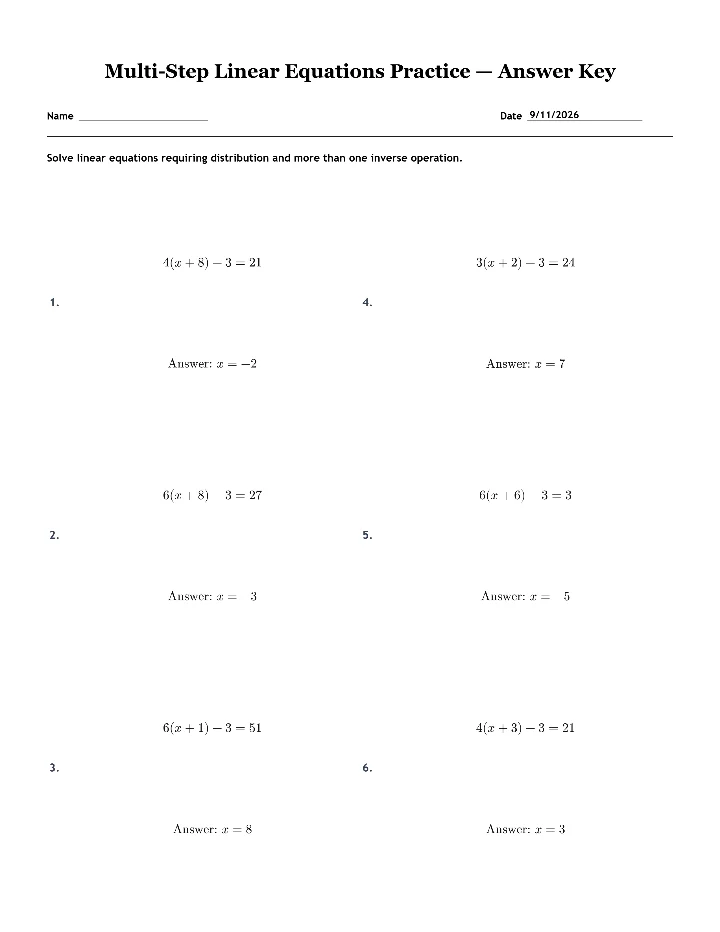
Free and quick to make. Choose a topic, use the suggested setup, and generate a worksheet with its answer key in just a few clicks.
Set the purpose before handing out the page
- 1
Name the skill precisely
‘Practice algebra’ is broad. ‘Factor trinomials before solving’ or ‘read domain and range from a graph’ gives students a clear target and makes review more useful.
- 2
Decide on tools in advance
Say whether calculators, formula sheets, graph paper, or notes are allowed. The same questions can practice reasoning or fluency depending on the tools available.
- 3
Review methods, not just totals
Choose one or two problems for students to compare approaches. A correct method that can be explained is more reusable than an answer reached by accident.
Grades 9-12 math topics
102 worksheet skills are grouped by learning goal. Choose any topic to open a teacher-friendly recommended setup in the builder.
Solve equations and use functions
44 skills- Function TablesComplete input-output tables, find missing inputs, and identify linear rules.
- One-Step EquationsSolve one-step equations with integer solutions.
- Two-Step EquationsSolve equations of the form ax + b = c.
- Slope From Two PointsFind slope from two coordinate points.
- Evaluate Linear FunctionsEvaluate linear functions at given inputs.
- Linear SystemsSolve two-variable linear systems with integer solutions.
- Algebraic ExpressionsEvaluate, combine, distribute, and factor algebraic expressions.
- Linear InequalitiesSolve one-step and two-step inequalities, including sign reversals.
- Polynomial OperationsAdd, subtract, multiply, divide, and evaluate polynomials.
- Radical ExpressionsSimplify, operate on, rationalize, and solve radical expressions.
- Rational ExpressionsSimplify, operate on, and solve rational expressions.
- Quadratic FactoringFactor monic quadratic expressions with integer roots.
- Quadratic Solutions & GraphsSolve quadratics and connect roots, vertices, discriminants, and graphs.
- Domain & RangeFind domain and range from relations, tables, mappings, formulas, and graphs.
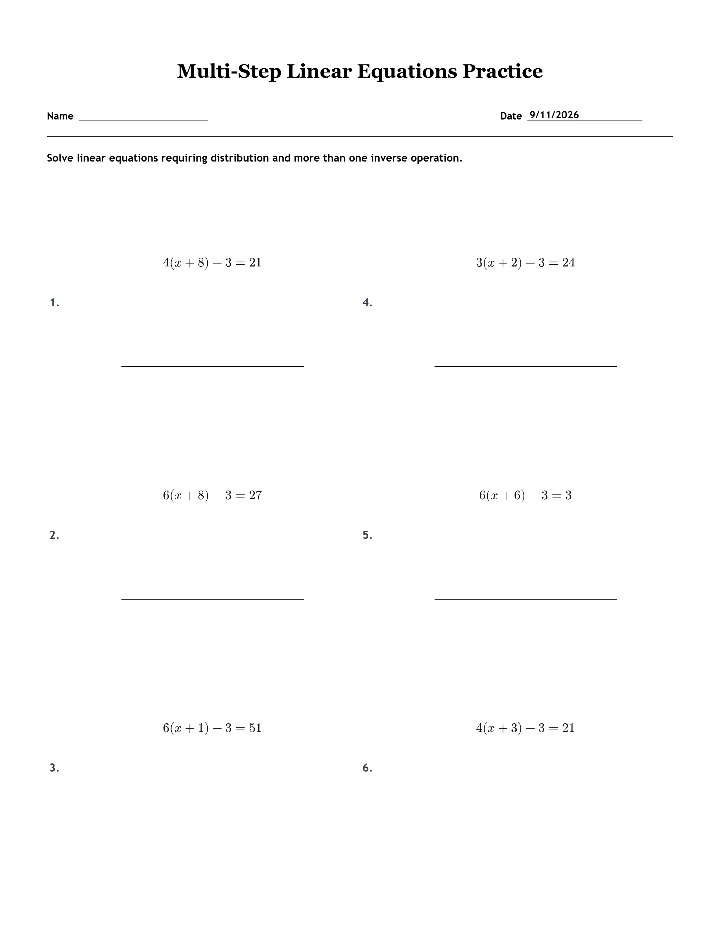
- Multi-Step EquationsSolve linear equations requiring distribution and more than one inverse operation.
- Variables on Both SidesSolve linear equations with variable terms on both sides.
- Literal EquationsRearrange formulas to isolate a requested variable.
- Absolute-Value EquationsSolve absolute-value equations and identify their two solutions.
- Rational EquationsSolve equations containing rational expressions and state excluded values.
- Radical EquationsSolve radical equations and check for extraneous solutions.
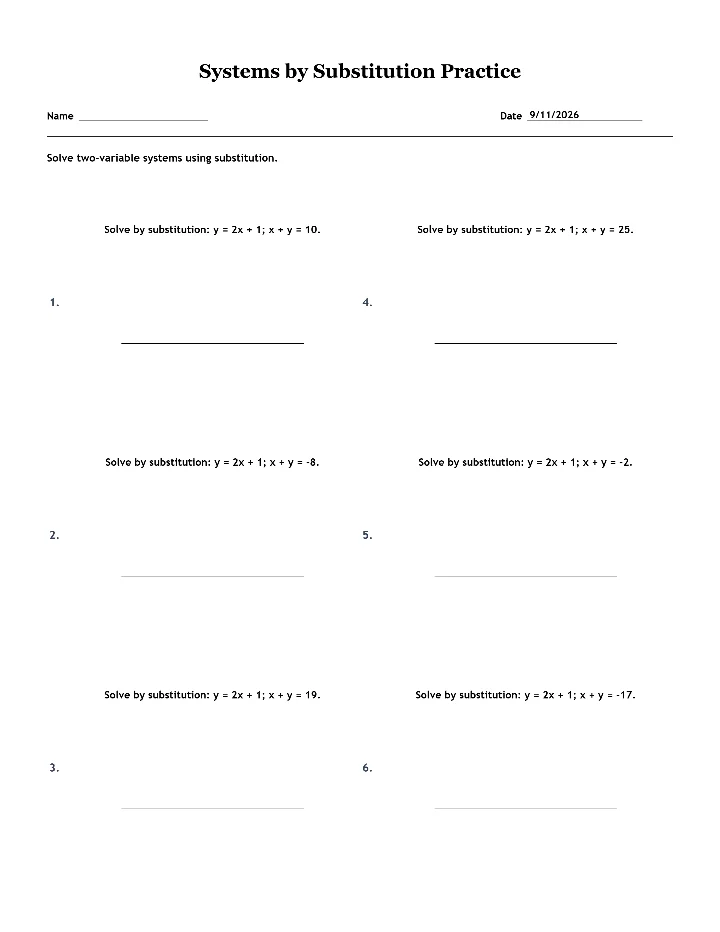
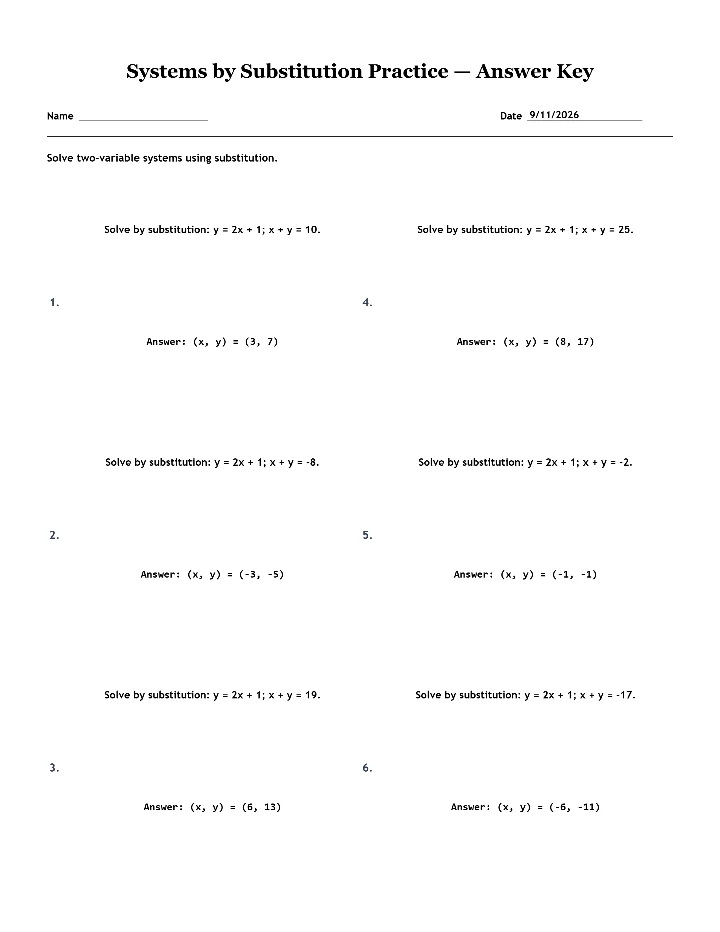
- Systems by SubstitutionSolve two-variable systems using substitution.
- Systems by EliminationSolve two-variable systems using elimination.
- Systems Word ProblemsTranslate contexts into systems and solve them.
- Systems of InequalitiesTest points and describe intersections of linear inequalities.
- Linear-Quadratic SystemsFind intersections of a line and a quadratic curve.
- Function NotationEvaluate functions and interpret function notation.
- Interpreting Graph FeaturesIdentify intercepts, extrema, signs, and end behavior from function descriptions.
- Average Rate of ChangeCalculate average rate of change over an interval.
- Function TransformationsDescribe translations, reflections, and stretches of parent functions.
- Piecewise FunctionsEvaluate piecewise-defined functions at boundary and non-boundary inputs.
- Function CompositionEvaluate and simplify compositions of functions.
- Inverse FunctionsFind and evaluate inverses of one-to-one functions.
- Comparing FunctionsCompare rates and initial values across representations.
- Completing the SquareRewrite quadratics in completed-square form.
- Quadratic FormulaSolve quadratic equations using the quadratic formula.
- Discriminant ClassificationUse the discriminant to classify quadratic roots.
- Polynomial Long DivisionDivide polynomials and report quotient and remainder.
- Synthetic DivisionUse synthetic division with a linear divisor.
- Remainder and Factor TheoremsConnect polynomial evaluation, remainders, and factors.
- Polynomial Zeros and MultiplicityRead zeros and multiplicities from factored polynomials.
- Exponential Growth and DecayModel and calculate repeated percent growth or decay.
- Compound InterestCalculate compound interest using standard formulas.
- Linear vs. Exponential ModelsDistinguish constant differences from constant ratios.
- Logarithm PropertiesExpand and condense logarithmic expressions and solve simple equations.
Measure shapes and triangles
9 skills- Pythagorean TheoremFind a missing side in right triangles.
- Triangle CongruenceIdentify valid triangle congruence criteria.
- Triangle SimilarityUse similarity criteria and proportional sides.
- Parallel-Line Angle RelationshipsApply corresponding, alternate, and same-side angle relationships.
- Coordinate Geometry ProofsUse slope, midpoint, and distance to verify geometric properties.
- Parallel and Perpendicular LinesWrite equations of parallel and perpendicular lines.
- Segment PartitionFind points that partition directed segments in given ratios.
- Circle TheoremsApply relationships among central angles, inscribed angles, chords, and tangents.
- Arc Length and Sector AreaCalculate arc lengths and sector areas using central angles.
Understand data and chance
19 skills- Standard DeviationCalculate and interpret population standard deviation.
- Distribution Shape and OutliersDescribe distribution shape and effects of outliers.
- Normal Distributions and Z-ScoresCompute z-scores and use normal-distribution percentages.
- Two-Way Frequency TablesCalculate joint, marginal, and conditional relative frequencies.
- ScatterplotsDescribe direction, form, strength, and unusual features in scatterplots.
- Correlation CoefficientInterpret the sign and strength of correlation coefficients.
- Regression LinesUse and interpret least-squares regression equations.
- ResidualsCalculate and interpret residuals from model predictions.
- Correlation vs. CausationDistinguish association from evidence of causation.
- Compound EventsRepresent unions, intersections, and complements of events.
- Conditional ProbabilityCalculate and interpret conditional probability.
- Independent EventsDetermine whether events are independent using probabilities.
- Probability RulesApply addition and multiplication rules of probability.
- Permutations and CombinationsCount ordered and unordered selections.
- Expected ValueCompute expected values and compare decisions.
- Sampling Methods and BiasRecognize representative samples and common sources of bias.
- Types of Statistical StudiesDistinguish surveys, observational studies, and experiments.
- Margin of ErrorInterpret confidence intervals and margins of error.
- Simulation-Based InferenceUse simulated results to judge whether an outcome is surprising.
Use exponents and complex numbers
6 skills- Exponential & Logarithmic FunctionsEvaluate, convert, and solve exponential and logarithmic forms.
- Sequences & SeriesWork with arithmetic and geometric sequences and finite series.
- Exponent RulesSimplify products and powers with exponent rules.
- Conic SectionsIdentify and graph circles, parabolas, ellipses, and hyperbolas.
- Complex ArithmeticAdd, subtract, and multiply complex numbers.
- Rational ExponentsRewrite and evaluate rational exponents and radicals.
Study change and accumulation
6 skills- Advanced Derivative RulesDifferentiate with product, quotient, chain, exponential, logarithmic, and trig rules.
- Definite IntegrationEvaluate definite integrals and basic area applications.
- Intro Differential EquationsSolve basic rate, growth, decay, and separable differential equations.
- Power Rule DerivativesDifferentiate polynomial terms with the power rule.
- Basic Power IntegralsIntegrate polynomial terms with the power rule.
- Polynomial LimitsEvaluate limits of polynomial expressions by substitution.
Work with matrices and vectors
3 skillsUse trigonometry and periodic functions
10 skills- Right-Triangle Trigonometric RatiosFind sine, cosine, and tangent ratios in right triangles.
- Missing Sides and AnglesUse trigonometric ratios to solve right triangles.
- Degrees and RadiansConvert angle measures between degrees and radians.
- Unit-Circle ValuesRecall exact sine and cosine values for special angles.
- Reference AnglesFind reference angles and signs by quadrant.
- Graphs of Sine and CosineIdentify key points, amplitude, midline, and period of basic trig graphs.
- Trig Function TransformationsAnalyze amplitude, frequency, phase shift, and midline.
- Inverse Trigonometric FunctionsUse inverse trigonometric functions to find angles.
- Trigonometric IdentitiesApply fundamental trigonometric identities.
- Law of Sines and CosinesSolve non-right triangles using the Laws of Sines and Cosines.
Model with quantities and units
5 skills- Dimensional AnalysisConvert compound units using dimensional analysis.
- Derived UnitsConstruct and interpret units such as density and acceleration.
- Measurement PrecisionChoose reporting precision consistent with measurement limits.
- Graph Scales and OriginsChoose and interpret graph scales without distortion.
- Density and Rate ModelingUse density and other derived rates in contextual models.