Area and perimeter worksheets
Find the area and perimeter of rectangles from their side lengths. Remember to include the correct units.
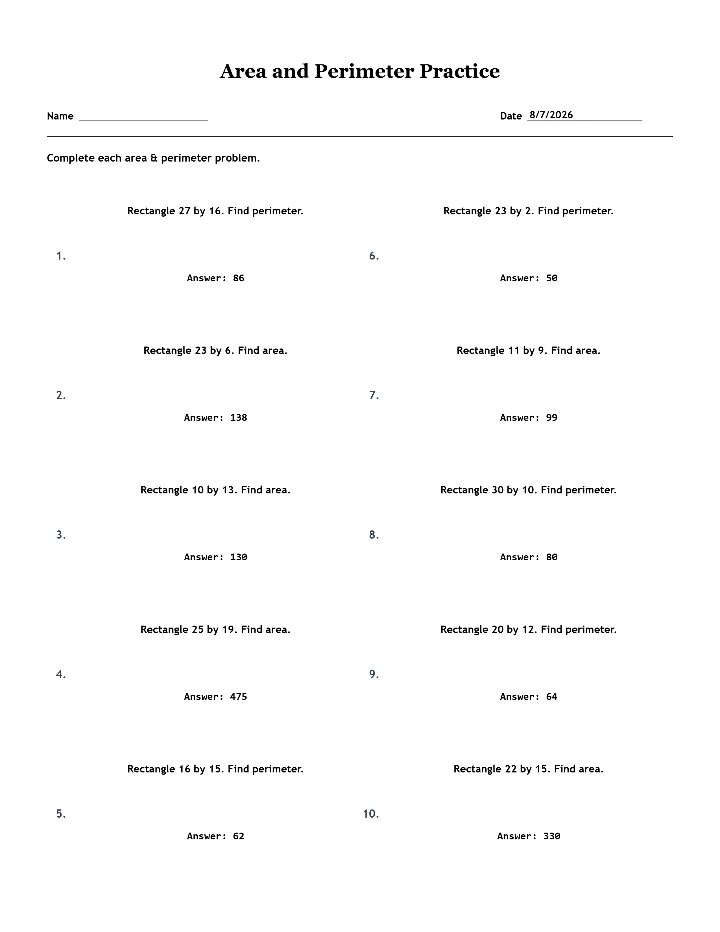
Sample worksheet
Download the sample worksheet and answer key, or open the builder to change the settings.
Download sample PDF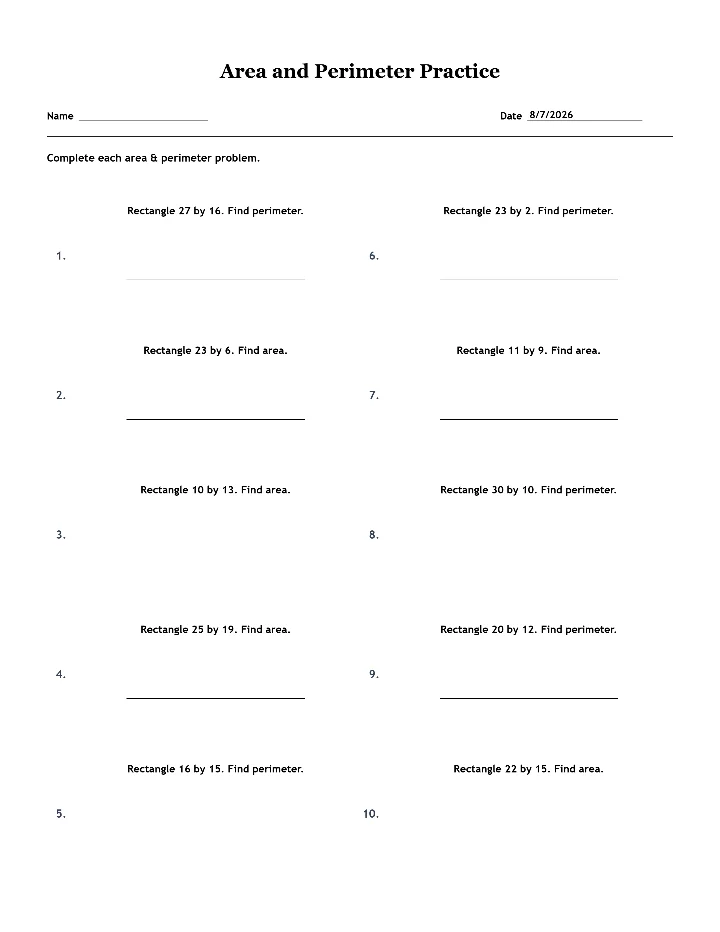
Change the settings
Before starting: Measure lengths in consistent units and distinguish the boundary from the interior of a shape.
After this: Find a missing side from a known area or perimeter, then combine rectangles into compound shapes.
Example questions
- Find the area of a 6 by 4 rectangle
- Find the perimeter of an 8 by 3 rectangle
- Find both measurements for a 9 by 5 rectangle
Settings in the builder
- dimension range
- area or perimeter mix
- units
Worked example
Find the area and perimeter of a rectangle 6 cm by 4 cm.
Answer: Area: 24 square cm; perimeter: 20 cm
How to solve it
Area counts 6 x 4 unit squares. Perimeter adds all four sides: 6 + 4 + 6 + 4. Use square units for area and length units for perimeter.
Common mistakes
What to check
- using the area formula for perimeter
- omitting square units for area
Ways to review the work
- 1
Trace the boundary for perimeter and shade the interior for area.
- 2
Draw two rectangles with the same area but different perimeters and compare their boundaries.
Teaching content updated 2026-09-05. Read our accuracy standards.